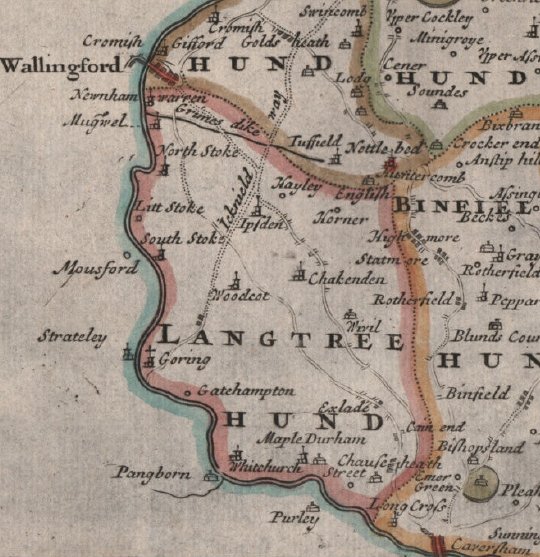
Morden's map of Oxfordshire
Most modern place names date from Anglo-Saxon Times (500-800 AD) and often are the only evidence we have for many settlements being in existence in Saxon times. The names are the last remnants of the Ancient Languages spoken in Britain such as Celtic and Old English (Anglo-Saxon). The English Language has changed so much that some old names mean very different things to the modern name. A sea is a lake, a down is an up, a tun is a village and a worth is a house. So the Berkshire Downs means the Berkshire Hills. The font in Urchfont means a spring not a religious font and Urch is the Anglo-Saxon word for deer so the name means the spring where deer drank. Some words are unchanged for example gravel, which gives us the name Gravely - the house where gravel is found. Some words are similar - Gat is now gate except in Yorkshire where Gate is a street and a gate is a bar.
Most people refer to the place they live in as 'the village' and topographic features such as rivers and hills are called 'the river' and 'the hill'.
The names of places appear to have been given by people from outside of the places. There are some curiosities such as the River Avon. When translated this means 'river river' - 'Avon' being the Celtic word for river and 'river' being an Anglo-Saxon word. One can just image a Saxon official called a reeve asking a surly Celtic local, who spoke a different language, the name of something and being told it was 'the river' or 'the hill'; or something fanciful for example being told that a valley was one where the elves lived which gives us the name Elvendon.
Until very recently Woodcote was called Uphill and South Stoke was called Downhill.
Spelling generally wasn't fixed until relatively recently so many modern names differ in how they are pronounced. Reading is pronounced 'Redding' - Read being the Anglo-Saxon word Red. Almost uniquely the date at which modern spellings were adopted can be determined by comparison of the maps made by Robert Morden for Oxfordshire and Berkshire. The Berkshire map shows the archaic spellings while the Oxfordshire Map shows the modern conventional spellings, both the maps date to 1718.
Morden's map of Oxfordshire
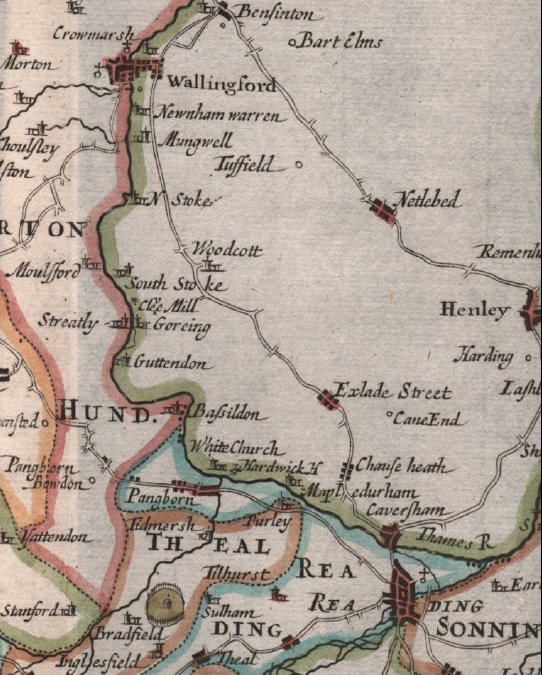
Morden's map of Berkshire
'White Church' which simply means 'the white church' (the Church made of White Stone) changed into Whitchurch and Goring is spelt Goreing. Cleeve is misspelled with a correction being added. Guttendon (Gatehampton) appears to be a spelling mistake and should read Gathanton.
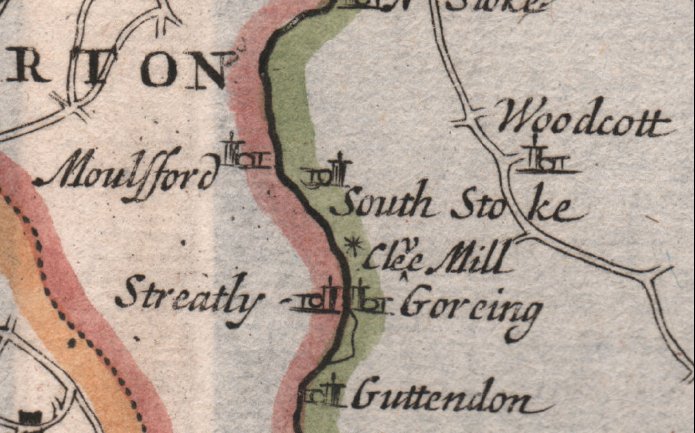
Detail of Morden's map of Berkshire
The 'ING' part of Goring is a common ending or part of Anglo-Saxon placenames. The first part of such placenames is usually a person's name and the 'ING' means the place where the children or people relating to the person's name lived, so Goring would be the place where the people of Gore lived. 'Gore', though, is not a person's name - it means a triangular piece of land and refers to the narrowest part of the river Valley at Goring - what is now called the Goring Gap, so Goring means 'the people who live on a triangular piece of land'.
Wallingford means the place where Wallis' children or people lived, where you could cross the river because there was a bridge or water was shallow enough to wade through, or ford, the river. Wallis appears to mean Welsh, which doesn't just mean people from Wales - before the Anglo-Saxons arrived it was also the name of the inhabitants of England. Indeed it is known that there has been a bridge at Wallingford since the Bronze Age, long before the Anglo-Saxons arrived.
Crowmarsh - The marsh where the crows live
Goring - The people who live on a triangular piece of land
Elvendon - The valley where the elves live
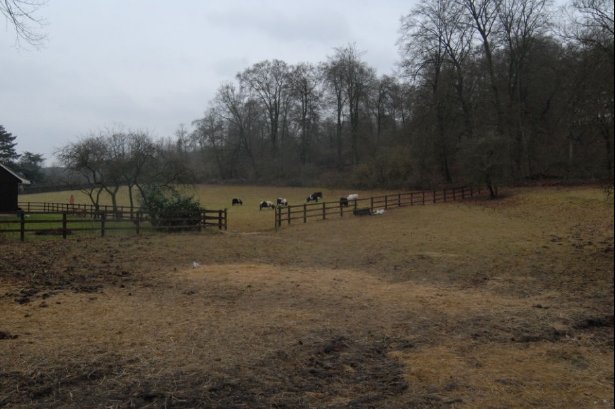
Grims Ditch - The ditch (and bank) dug by the Devil
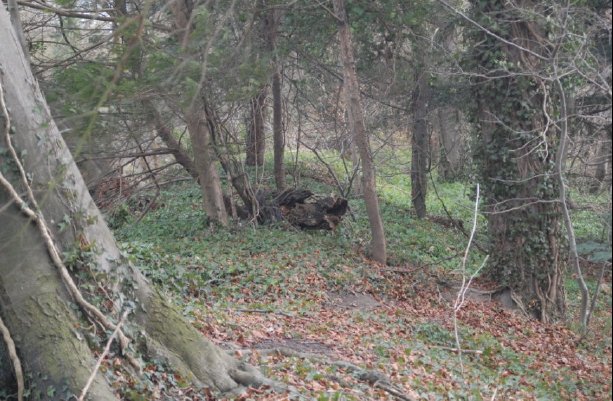
Mungewell - Munge's (a person's) well or spring
North and South Stoke - Stoke means either 'holy place' or 'cattle farm'
Moulsford - The place where the river could be crossed (ford) owned by Mul
Streatley - The meadow in the woods on a Roman Road
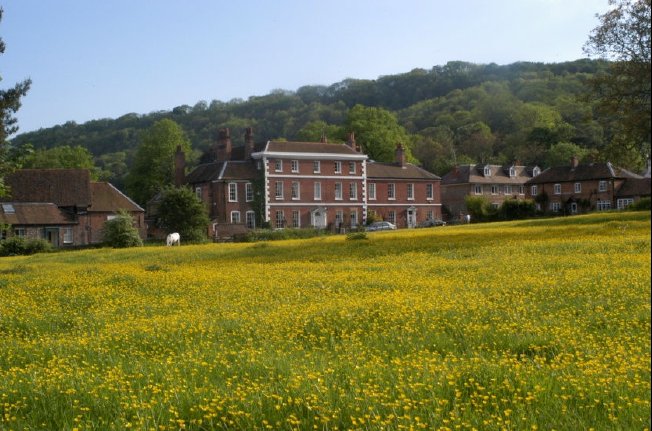
Wallingford - The place where the people of the Welsh bridge lived