Buy a copy of 'Invitation to Good Cheer' for £14.00 including P&P
The Catherine Wheel is the quintessential English Pub being a timber-framed building with many beams and inglenook fireplaces. Invitation to Good Cheer describes the history and evolution of this pub set in the context of the evolution of pubs generally.
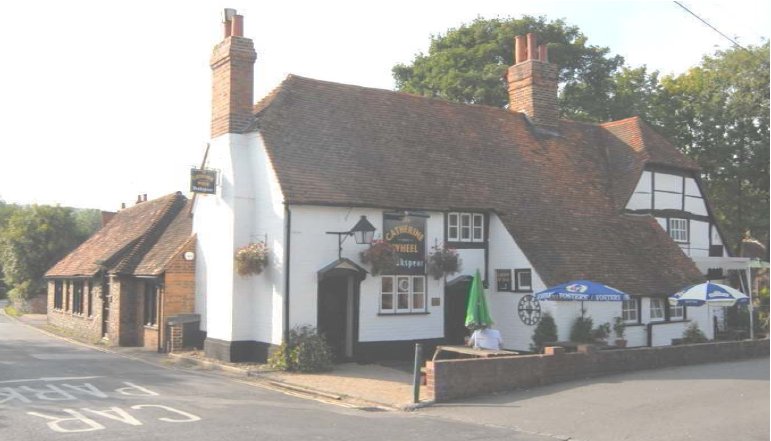
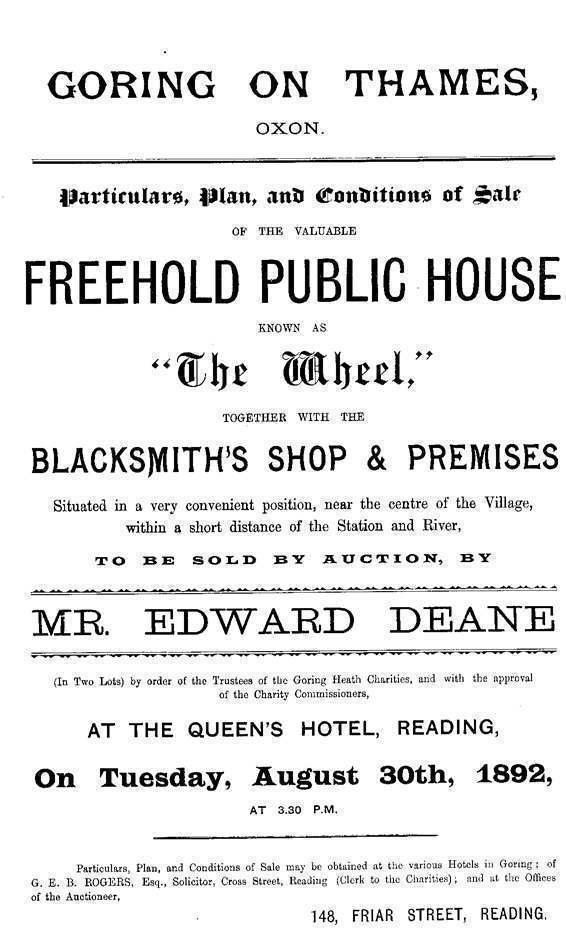
In 1679 Henry Allnutt bought the manor of Goring and other lands thereabouts with the intention of building some almshouses (houses for the poor) as part of an endowment when he died. He died on the 11th March 1724 and the Henry Allnutt charities were founded; the bequest included his messuages (cottages) in Goring. And thus the story of 350 years of beer drinking in the Catherine Wheel, Goring on Thames begins. This was an era when beer was consumed as a staple part of the diet and even children would drink many pints a day. At least eight pints was the order of the day for a man.
The consumption of alcohol began in Britain when the Neolithic temple at the end of the Ridgeway was newly built. The public house is a much-loved historic and distinctive building but, in fact, is actually a relatively recent phenomenon emerging in the middle of the nineteenth century. The term 'public house' made its appearance in the late 17th Century (and the abbreviation 'pub' is first recorded in 1812 - the year of the battle of Waterloo). The ancestors of the pub, inns, taverns, beer houses, ale houses and cider houses, all have their origins in the medieval period and were familiar terms to everybody. These terms cover a variety of purposes but all connected with the serving of drink and food as well as providing shelter.
The earliest English written works contain references to drinking and feasting in the nobleman's hall. The first written English Laws, written by King Alfred, contain many references to drinking. His successor, Aethelred, passed a law relating to breach of the peace in an 'Alehouse' - if somebody was killed in such a disturbance, the fine was six half marks (£1) but if nobody was killed the fine was lower.
William the Conqueror's great survey of England in 1086 has a few references to brewing but none to buildings that sold ale. In fact the only reference to the sale of alcohol is a local law in Chester, which said that a visit to the ducking stool or a fine of four shillings could be imposed on somebody brewing bad ale. A ducking stool consisted of a trolley mounted on wheels with a long pole and a chair fastened to the end of it. The poor unfortunate woman (for brewing was almost exclusively the domain of women who were often known as alewives) was strapped into the chair and dragged around the locality before being ducked into ponds and rivers.
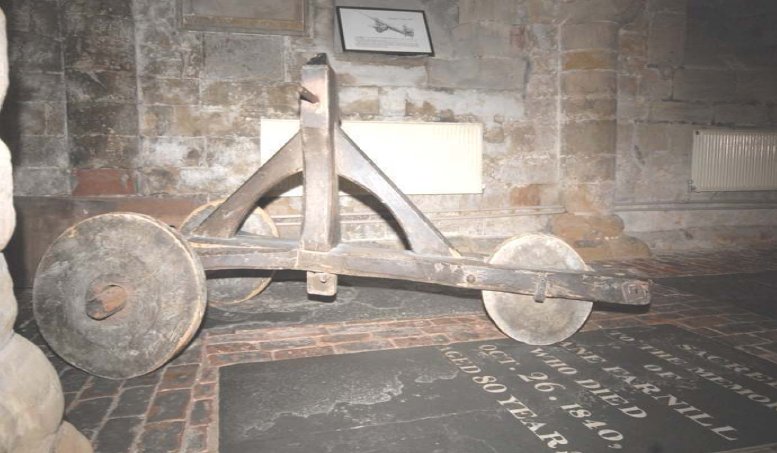
One of the few ducking stools that survive is on display in the crypt of
Warwick Parish Church
At the end of the fourteenth century a number of factors changed this well-established pattern dramatically - the Black Death caused a shortage of labour. Wages therefore increased and thus the number of women needing to supplement their income declined. In Germany hops had been used in the brewing process since the ninth century, producing 'beer' - traditionally a word for hopped ale. With the rise of the wool trade in the late thirteenth century, beer was imported into England. Beer had the advantage over ale in that it had better keeping qualities and thus was suited to brewing on a larger scale. Beer proved very popular and soon the hops rather than the finished product were being imported. Shortly after, hops began to be grown in Kent and Sussex.
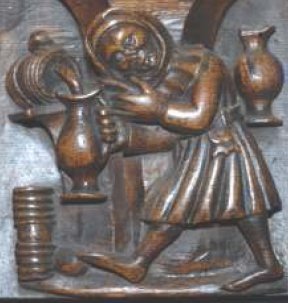
The ale or beer house was simply a domestic building with a room set aside for drinking, often where the beer was brewed.
A tavern was a building selling wine. These were restricted to towns and they did not offer accommodation.
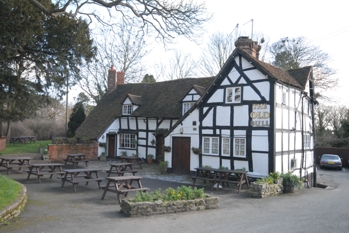
The Quintessential Village Pub: The Old Bull Inn, Inkberrow, Worcestershire. Many notable Englishmen, including Shakespeare, have
drunk in this pub, better known as the Bull at Ambridge - the pub in the British
radio series, 'The Archers'.
An Inn was a house offering accommodation, the word itself originally meaning the townhouse of an aristocrat or wealthy merchant. The earliest pubs are in fact all inns, the earliest being the George at Norton St Philip (defined by being a purpose built building and/or having continuous records for the sale of beer). These early inns were usually constructed by monasteries and run by monks. The monasteries in the early medieval period derived a good income from offering accommodation for travellers and were very much involved in commerce. In the late thirteenth century, trade was more commonly carried out in towns and the monasteries were suffering a loss of trade. In response the monasteries started building inns in towns or in places where travellers congregated. One thing that characterises such religious foundations is the name of the pub which is usually a reference to a saint such as The George or The Catherine Wheel, or other Christian imagery, e.g. The Angel. Locally at Chalgrove the Red Lion Inn is still owned by the Church.
From the middle of the seventeenth century public staging coaches became the main means of travel and an infrastructure was built to serve this mode of transport. Along the route inns were constructed to provide food and drink for the travellers and a change of horses for the coach. These building are characterised by a yard, where the coaches could be turned, stable blocks and other similar buildings. In general they were large buildings.
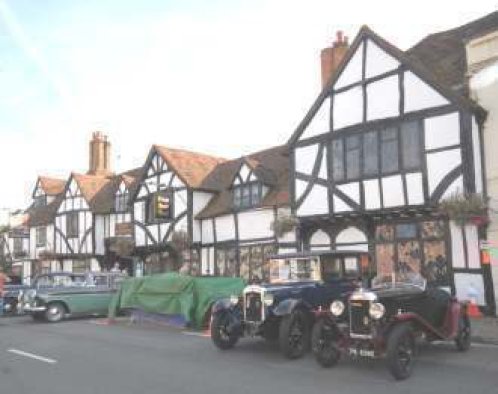
The Kings Arms at Amersham, a coaching inn. This is the pub featured in the
film 'Four Weddings and a Funeral'
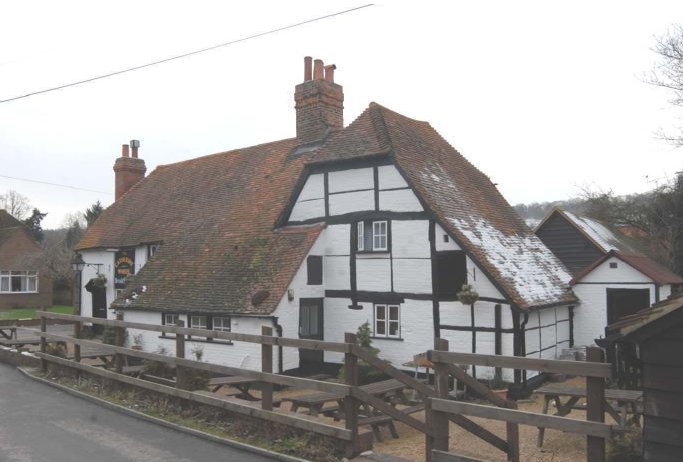
The Original Catherine Wheel
The Catherine Wheel is an example of a Jacobean type of building known as a lobby house - this consisted of a lobby with two rooms off of it. On the opposite side of the building was a small staircase leading to two rooms upstairs. For this reason we can be reasonably sure of what the building would have looked like, extrapolating from what survives. The building is constructed around a timber frame which was prefabricated off-site and the timbers were numbered to simplify their erection on site. The builders would enlist the help of local people and the frame would be completed in 2 or 3 days. The panels were filled in with wattle and daub, wattle being small sticks interwoven and daub being a mix of clay, animal dung and straw applied to the wattle. If kept dry it was a very serviceable means of filling the panels in a timber-framed house. A coat of lime wash made the material more durable.
A number of original elements survive in The Wheel - although most are at first floor level. On the front elevation the original timber frame is still visible.
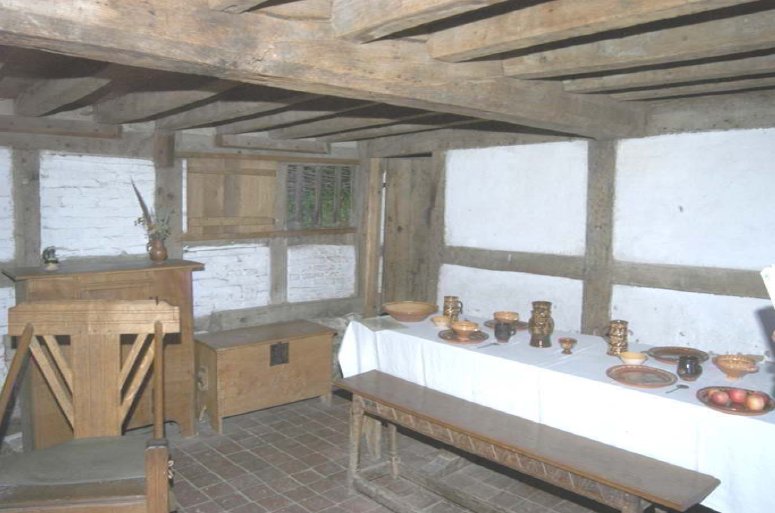
How the interior of The Wheel may have looked when it was built
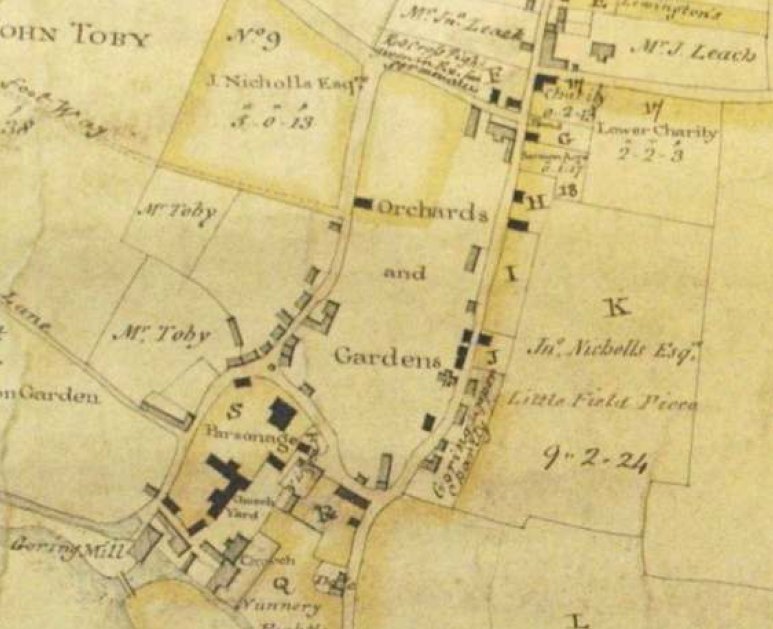
The 1787 Survey of Goring (Oxford County Council Record Office)
The Wheel can be identified as the building perpendicular to the easternmost
north-south road below the word 'Gardens'
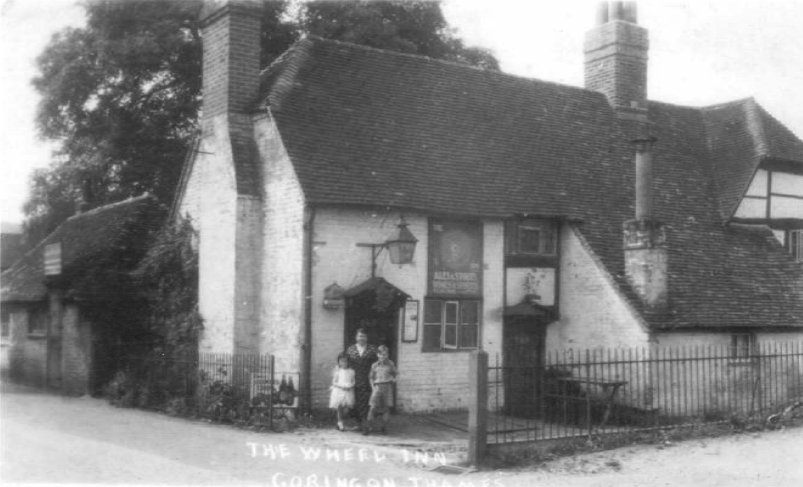
The Catherine Wheel in 1938
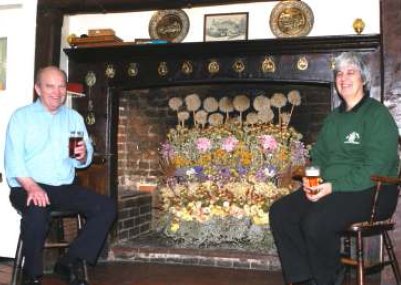
Ray & Diana Kerr, Licensees of The Wheel, 1992-2004